
Bond and Bail Denial in Travis County, Texas
Estimated Read Time: 9-10 Minutes
In Travis County, Texas, bail denial is a significant legal hurdle, but it is not necessarily final. Texas law provides several mechanisms to challenge a no-bail order or to seek a reduction if bail is set at an unattainable amount. Don’t panic! There are multiple resources in Travis County available to help you, each offering different options for your friends and family. They might need your help in gathering information on their behalf, so let us help you to learn the lay of the land.
 Key Takeaways
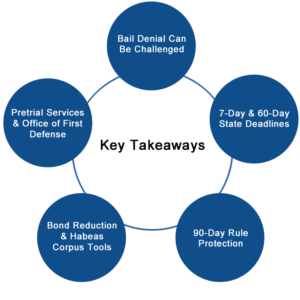
Bail denial is not final: While a no-bond order is a serious hurdle, Texas law provides several legal mechanisms to challenge the denial or seek a reduction to a more affordable amount.
Strict deadlines for the state: If bail is denied, the prosecutor must prove their case at a hearing within 7 days, and the state must generally bring the person to trial within 60 days, or the no-bond order expires.
Protections against long delays: Under the 90-day rule, if the state is not ready for trial on a felony charge within 90 days, the judge must either lower the bail or release the person on a personal bond.
Tools for legal challenge: Attorneys can file a motion for bond reduction to argue for a lower price based on community ties, or an application for writ of habeas corpus to immediately appeal an unfair detention to a higher court.
Specialized support resources: Departments like Pretrial Services and the Office of First Defense work to protect a defendant’s rights from the moment of arrest, gathering information and advocating for release at initial hearings.
Motion to Deny Bail
A motion to deny bail is the government’s formal request for a judge to suspend a person’s constitutional right to go home while they await trial. The law says that the state cannot simply refuse to set a bond. To keep an individual incarcerated, they must file this motion to prove in court that the person poses an excessive risk of reoffending or fleeing. This usually happens in cases involving very serious crimes, like capital murder or violent sexual offenses, or if the person has a history of multiple felony convictions.
This triggers a special hearing that must be held within 7 days of the arrest. At this hearing, the prosecutor must present substantial evidence to a judge to convince them that the person in question is a danger to the community or likely to flee. If the judge agrees with the prosecution, they must sign a formal written order that explains exactly why bail is being denied.
This order isn’t just a no. The response also acts as a legal timer. Once bail is officially denied, the state is placed on a strict 60-day deadline to start the trial. If the 60th day passes and the trial has not begun, the no-bond order automatically expires, and the judge must set bail so the person has a chance to be released. This process ensures that the government cannot leave someone in jail indefinitely without proving their case quickly.
Motion for Bond Reduction or Reconsideration
If your loved one is denied bail in Travis County, the first thing their lawyer will usually do is file a motion for bond reduction or reconsideration. This is an immediate legal recourse that formally asks a judge to lower the cost of a person’s release. Texas law is very clear that the purpose of bail is only to ensure a person shows up for their court dates, and bail cannot be used as an instrument of oppression or as a way to punish someone before they have been convicted of a crime.
When a lawyer files this motion, they are essentially telling the judge that the current price of freedom is higher than the family can afford, which is legally considered unfair if the person isn’t a flight risk. To win a bond reduction, their attorney will hold a hearing to demonstrate the person’s local ties to the community. Think of local ties as the reasons why the person wouldn’t run away, such as a steady job, family living nearby, or many years of living in the community.
Their attorney might also use this time to present bank statements or pay stubs to demonstrate that the current bail amount exceeds the family’s means. If the judge is convinced that the person will follow the rules and pose no danger to the public, they can lower the bond to a more reasonable amount. In many cases in Travis County, a lawyer can even skip the big court fight by reaching an agreement with the prosecutor for a lower bond, which a judge can then sign quickly to get the person home sooner.
Application for Writ of Habeas Corpus
A writ of habeas corpus is a powerful legal tool that challenges the lawfulness of a person’s detention. While a motion to lower bail is a polite ask for the judge to change their mind, a writ is a formal claim that a person’s constitutional rights are being violated. This is the primary way to challenge bail that is set so high that it is effectively impossible for the family to pay. In the eyes of the law, a million-dollar bond for someone with no money is often treated as no bond at all, which is usually considered unconstitutional.
The biggest advantage of using a writ is that it creates a safety net for an appeal. If a local judge refuses a standard motion, you are typically stuck with that decision for a long time. However, if a judge denies a request for a writ of habeas corpus, the attorney can immediately appeal to a higher court of appeals to have the decision double-checked. This is called an interlocutory appeal, and it is the fastest way to get a higher authority to step in if a local judge is being unfair. By filing a writ, the lawyer forces the government to bring the person to court and prove exactly why such a high bail is necessary, ensuring that the person isn’t just left in jail because they are poor.
 7 Day Proof Window
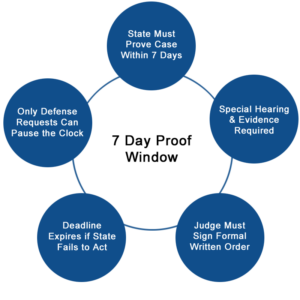
Think of the 7-day proof window as a fast-track deadline the government must meet to keep someone in jail without bail. In Texas, the law assumes that everyone has a right to bail unless the state can prove there is a very good reason to deny it. Because being held without bond is such a serious matter, the prosecution only has 7 calendar days from the moment a person is arrested to prove its case to a judge. During this week-long window, the state must hold a special hearing in which it must present significant evidence showing that the person likely committed the crime and is too dangerous or a significant flight risk to be released.
For bail denial to be legal, it isn’t enough for the judge to merely agree with the prosecutor verbally. The judge is responsible for a formal written order that they must sign before the 7-day clock runs out. This document serves as the official legal justification for denying a person bail. If the seven days pass and the state has not held the hearing or the judge hasn’t signed the paperwork, the no-bond status expires. When this happens, the person is no longer legally held at zero bond, and the judge is required by law to set a specific bail amount so the person has a chance to go home.
The only common reason this 7-day deadline would be extended is if the defense lawyer asks for more time. Sometimes a lawyer needs extra days to gather evidence or talk to witnesses to win the hearing, and if they officially request a delay, the clock pauses. However, if the delay is caused by the prosecutor or the court being too busy, the deadline still stands. This rule is designed to make sure the government can’t just leave someone in jail indefinitely without proving to a court, very quickly, that it is absolutely necessary.
60 Day Trial Deadline
The 60-day trial deadline is a critical protection for anyone being held without bail in Texas. If a judge signs an order to deny bail, the state has a 60-day window to bring that person to trial. The law views a no-bond order as an emergency measure, not a permanent status. Because the person is sitting in jail despite being presumed innocent, the government is forced to put that case at the front of the line. If the 60th day passes and the trial has not yet begun, the order expires by law, and the judge must set a reasonable bail amount.
There is a very important catch regarding who is responsible for delays. The 60-day clock counts only time attributable to the government or the court. If the defense lawyer asks for a continuance to prepare, those extra days do not count toward the 60-day limit. Essentially, the clock pauses whenever the defendant asks for more time. For the deadline to work in your friend or family member’s favor, the defense must be ready and willing to go to trial, while the state is the one causing the hold-up.
It is also important to understand what starting the trial actually means. In Travis County, this usually means the moment jury selection begins. The state doesn’t have to finish the entire trial within 60 days, they just have to officially begin the proceedings. If they fail to do so, the attorney can file a motion to have bail set immediately. This deadline ensures that the state cannot use a no-bond order to keep someone in jail for months or years while they slowly build their case.
90 Day Rule
Think of the 90-day rule as a use-it-or-lose-it deadline for the prosecution. The law says that if someone is in jail on a felony charge and the District Attorney is not ready to start the trial within 90 days, that person cannot be kept locked up simply because they are unable to afford a high bail. Once that 90th day hits, if the state isn’t fully prepared to move forward, which usually means they haven’t secured a formal indictment from a grand jury, the judge is legally required to either release the person on a personal bond, which costs no money, or lower the bail amount to something the family can actually afford to pay.
This rule is designed to prevent the government from leaving people in jail for months while they slowly build their case. It is important to know that the state is usually considered not ready if they haven’t officially filed the formal charges or indictment by that 90-day mark. If the delay is caused by the defense attorney asking for more time to investigate, the clock stops ticking. Additionally, if the person is being held for other reasons, such as a warrant from another county or a parole violation, this rule might not result in their being released from jail entirely, even if the current charge hits the 90-day limit.
Release Due to Prosecutorial Delay
The rule regarding release due to a prosecution delay is a legal clock that prevents the government from keeping someone in jail indefinitely while it takes its time building a case. Texas law recognizes that if you are in jail but haven’t been convicted of anything, the state has a limited amount of time to be ready for your trial. If they miss this deadline, they can no longer keep you locked up just because you are unable to pay a high bail amount.
The length of this clock depends on the seriousness of the charge. For a felony, the state has 90 days to be ready. For a serious misdemeanor, the penalty decreases to 30 days, and for a minor misdemeanor, to just 15 days. If the state is accused of a crime that only carries a fine, they must be ready within just 5 days.
In a felony case, the state is almost never considered ready unless it has obtained a formal indictment from a grand jury. If the 90th day passes and your friend or family member has not been indicted, their lawyer can ask the judge for an immediate release. By law, the judge must then either release them on a personal bond, which costs no money, or lower the bail to a more affordable amount.
It is important to note that this rule is not automatic and does not apply if the delay was caused by the defense lawyer’s request for more time. Furthermore, if the person is being held for other reasons, such as a warrant from another county, a parole violation, or if they are found incompetent to stand trial, this rule might lower the bond for the current charge, but it will not necessarily result in their being released from jail entirely while those other legal holds remain in place.
FAQs
Is a no-bond order permanent? No. A no-bond status is often a temporary measure while the court awaits additional information or a formal hearing.
Can the judge deny bail just because the charge is serious? Usually, no. The law says almost everyone has a right to bail. A judge can only deny it for specific offenses, such as capital murder, certain violent or sexual felonies, or if the person has two prior felony convictions.
What is the 60-day rule for people denied bail? If a judge officially denies bail after a hearing, the state is placed on a strict deadline. They must bring the defendant to trial within 60 days of the denial.
What if the state isn’t ready for trial, but my family member is still in jail? If the prosecutor is not ready for trial within 90 days for a felony (or 30 days for certain misdemeanors), the judge must either release the person on a personal bond or reduce the bail to an amount the family can actually afford to pay.
Can we appeal the judge’s decision to deny bail? Yes. If a judge refuses to set bail or sets it at an impossible amount, your attorney can file an Application for Writ of Habeas Corpus.
 Travis County Pretrial Services
Travis County Pretrial Services is a county department that serves as a neutral information-gatherer for the courts. Their main job is to interview people in jail to determine whether they are good candidates for a personal bond, which allows a person to be released by promising to return to court rather than paying cash to a bondsman. During this process, an officer will verify the person’s identity, call their family or employer to confirm their local ties, and check their criminal history. They then recommend to the judge whether the person should be released and what conditions they should follow, such as drug testing or an ankle monitor.
If pretrial services denies a personal bond, it usually means they are concerned that the person might not show up for court or could be a danger to the community. However, it is important to understand that their denial is not the final decision. Only a judge has the power to officially deny bail. If pretrial services says no, a lawyer can still present the information they gathered to a judge to argue that the person should be released anyway.
You can reach the Pretrial Investigations Unit at (512) 854-9381 to check the status of a bond application or to provide them with the contact information for references who can vouch for your loved one.
Once someone is released, this department also handles case management. This means they are the supervisors who make sure the person follows all the court’s rules while the case is ongoing. They monitor everything from GPS tracking to alcohol sensors and report back to the judge if any rules are broken. Essentially, they serve as the link between the defendant and the court, ensuring the person stays on track and appears for all scheduled dates.
Office of First Defense
The Office of First Defense is a specialized team of lawyers whose entire job is to be by a person’s side the very first time they see a judge after being arrested. In Travis County, this first meeting is called magistration. This is where a judge decides if a person can be released on bond and what rules they must follow. Before this office was created in 2024, many people had to face this critical moment alone, without a lawyer to speak for them. Now, OFD attorneys are available at the jail nearly 20 hours a day to provide counsel at the first appearance to ensure a person’s rights are protected from the very beginning.
When it comes to bond denial, think of the Office of First Defense as an immediate shield. They argue directly to the judge for lower bail amounts or for personal bonds that don’t cost any money, often using evidence about the person’s job, family, or health that the judge might not otherwise know. If the judge still decides to deny bail, the OFD attorney makes sure the legal reasons for that denial are clearly recorded. This is vital because it creates a paper trail that a future lawyer can use to file a formal appeal or a motion to change the judge’s mind later on.
While the Office of First Defense handles only the initial high-stakes hearing, they work closely with social workers and case managers who seek resources such as housing or treatment programs that might give a judge confidence to release someone. Once this initial hearing is over, the OFD hands the case off to a long-term lawyer, such as the Public Defender, and their early work often sets the stage for a bond reduction or release further down the road. You can contact their team through the Travis County Office of First Defense website to learn more about how they support people in the hours immediately following an arrest.
Travis County Public Defender’s Office
The Travis County Public Defender’s Office is a team of government-funded lawyers and specialists who represent people who cannot afford to hire a private attorney. While the Office of First Defense handles the very first few hours after an arrest, the Public Defender’s Office takes over the case for the long haul. Their main goal is to protect the person’s constitutional rights and work toward the best possible outcome for the case, which often begins with fighting to get them out of jail while they wait for their trial.
When it comes to a bond denial, the Public Defender’s Office acts as the primary legal engine for a challenge. If a judge has refused to set bail or set it at an amount the family cannot pay, the public defender will file formal legal documents, such as a motion for a bond reduction or a writ of habeas corpus, to obtain a new hearing. Unlike some traditional law offices, the TCPD uses a holistic model, which means they don’t just have lawyers, they also have social workers, case managers, and mitigation specialists on staff. These specialists look for underlying issues, like mental health needs or lack of housing, and create a release plan to show the judge that the person can be safely supervised in the community rather than kept in a cell.
The office is located at 1010 Lavaca St. (2nd Floor) in Austin, and they can be reached at (512) 854-5100. If someone you know is being represented by this office, you can contact them to provide mitigation information, such as proof of a job, medical records, or letters from family, that their team can use to convince a judge to reconsider the bond denial. Because they work closely with other local resources, they are often the best point of contact for navigating the specific bond-review dockets in Travis County that give defendants a second chance at release.
Special Bond Review Dockets
Special bond review dockets are a specific type of court hearing in Travis County designed to give people a second look if they remain in jail because their bond was denied or set too high. One of the most common versions is the special reduction docket, which is held twice a week and focuses specifically on people identified as having mental health needs. This program uses a team approach where defense lawyers, prosecutors, and mental health professionals work together to find a safe way to release someone into treatment or supervision rather than keeping them in a cell. The court is actually required to consider these mental health factors when deciding whether to keep someone in custody.
For cases that don’t involve mental health, Travis County also uses a bond review docket for both felonies and misdemeanors. This is an automated system that periodically reviews a list of everyone currently in jail to see whether their circumstances have changed or whether the state is taking too long to move the case forward. If your family member or friend is on this docket, it means a judge will re-evaluate their case without the family necessarily having to file a new motion every week. The judge considers whether the person has been indicted and whether the original bond conditions remain necessary for public safety.
There is also an uncontested docket that happens every weekday morning and afternoon. This is not a formal hearing where you argue before a judge. Instead, this is a time set aside for a duty judge to quickly sign agreed orders. If your attorney and the district attorney have already talked and agreed to a lower bond or a personal bond, they take the paperwork to this docket to get it signed immediately. This is often the fastest way to secure a release in Travis County, as it bypasses the need for a long, scheduled court battle.
Pending or Referred Bail
Seeing the status as pending or referred on a legal record does not mean bail has been denied. Seeing this can simply mean that the court system is still completing the necessary paperwork before a judge can set a price for release.
A judge must set bail within 48 hours of an arrest. During this short waiting period, the status is often listed as pending because the court is waiting for a mandatory background check, called a public safety report, to be completed, or because pretrial services is still interviewing the person to determine whether they qualify for a free personal bond.
The term usually refers to the fact that the first judge who saw your friend or family member did not have the specific legal authority to handle their type of case. In Texas, certain serious charges or special motions can be handled only by a district judge, not a general magistrate. When this happens, the case is referred to a higher court where a specialized judge will review the details and set the bond amount. This is a standard part of the process, and once the correct judge receives the file and all the background information is verified, the pending status will be replaced with a specific dollar amount or a bond condition.
 No Bond Offenses
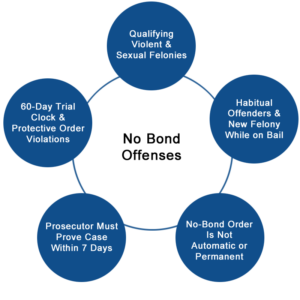
A no-bond offense is a serious crime in which a judge may deny a person their usual right to bail. While the law guarantees that almost everyone has the right to pay for their release while awaiting trial, certain situations are considered so high-risk that the state can keep someone in jail for the safety of the community, provided the evidence is very strong. This includes capital murder and a list of violent or sexual felonies like aggravated assault with a deadly weapon, aggravated kidnapping, aggravated robbery, and human trafficking. Bail can also be denied if a person is a habitual offender with two prior felony convictions or if they are accused of committing a new felony while already out on bail for a previous one.
It is important to understand that even if someone is charged with one of these crimes, a no-bond order is not automatic or permanent. For the denial to stick, a prosecutor must go before a judge within seven days of the arrest and present evidence that the person is likely guilty and too dangerous to be released. If the judge agrees to deny bail, the state is then placed on a strict 60-day clock to start the trial. If the prosecution isn’t ready by then, the no-bond status expires, and a bail amount must be set. Additionally, bail can be denied if a person violates a protective order or a specific safety condition of their release, but even then, they are entitled to a hearing where their lawyer can fight to keep them out of jail.
Putting Your Best Foot Forward
As you now know, there are many paths forward if a loved one’s bail is denied. It can help to be proactive, and gathering information about their ties to the community, their financial situation, and their career can be a critical way to help them put their best foot forward. We are here to guide you through this process and help you better understand their rights under the law, and to show you what you can do to help.
Call (512) 469-6056 or Schedule a Free Case Evaluation Online